A technical analysis based on the ONNX embedding benchmark suite: Github Repo
Abstract
Embedding models map text into dense vectors so that semantic similarity can be measured with cosine similarity or inner product. In retrieval-augmented generation (RAG), those vectors determine which passages reach the language model—and therefore how correct the final answer is.
This article surveys the main types of embedding models represented in this project, explains how they differ in architecture and intended use, and analyzes empirical performance from the checked-in benchmark: nine model families under 1B parameters, exported to ONNX and evaluated at multiple precisions (fp32, fp16, q4). Results show a clear speed–quality frontier: tiny MiniLM models exceed 140 queries per second but score low F1 on the RAG task, while Qwen3-0.6B, ModernBERT-base (q4), and BGE-M3 cluster near ~49–51 F1 at much lower throughput. Quantization is not uniformly harmful; for several families, q4 preserves accuracy and multiplies retrieval speed.
1. Introduction
1.1 Why embedding choice matters
A RAG pipeline typically does four things:
- Chunk and embed a document corpus
- Index the vectors for nearest-neighbor search
- Embed each user query and retrieve top-
chunks - Pass retrieved context to a generator LLM
Step 3 is cheap relative to generation, but retrieval quality dominates answer quality. A fast embedder that misses the right passage forces the LLM to invent or fail. A slow, accurate embedder can become a bottleneck for interactive systems or large batch indexing.
This project isolates that tradeoff by fixing the rest of the stack (same documents, same questions, same generator path, same scorer) and varying only the ONNX embedding model and its numeric precision.
1.2 Scope of this repository
| Aspect | Detail |
|---|---|
| Focus | Embedding models under ~1B parameters |
| Runtime | ONNX Runtime (CPU-oriented deployment path) |
| Precisions studied | fp32, fp16, q4 (additional variants exist on disk) |
| Evaluation | End-to-end RAG with RAGChecker F1 + retrieval search-time throughput |
| Corpus | Three mixed-domain documents, 15 evaluation questions |
2. What Is an Embedding Model?
2.1 Representation
Given a tokenized sequence
- CLS token — use the representation at a special classification token
- Mean pooling — average last-layer hidden states (optionally mask-aware)
- Last-token / EOS pooling — typical for decoder-style embedding models
Similarity is usually
2.2 Training objectives (conceptual)
Modern text embedders are rarely plain language-model checkpoints. They are typically trained or fine-tuned with:
| Objective family | Idea | Typical products |
|---|---|---|
| Contrastive / InfoNCE | Pull query–positive pairs together; push negatives away | MiniLM sentence transformers, many BGE models |
| Multi-task retrieval | Dense + sparse + multi-vector signals | BGE-M3 |
| Instruction / task prefixes | Condition the vector space on the task (“query: …”, “passage: …”) | EmbeddingGemma, some Qwen3 embedding setups |
| MLM pretraining then adaptation | Strong bidirectional encoder, then retrieval fine-tune | ModernBERT, classic BERT/BGE |
Architecture and training recipe together define the type of embedder more usefully than parameter count alone.
3. A Taxonomy of Embedding Model Types
The models fall into five practical categories. The taxonomy below is intentional for RAG practitioners, not a pure academic genealogy.
Text embedding models (this repo)
├── 1. Compact sentence transformers (MiniLM)
├── 2. Classic English retrieval encoders (BGE-EN)
├── 3. Multilingual multi-function encoders (BGE-M3)
├── 4. Modern long-context bidirectional encoders (ModernBERT)
└── 5. LLM-backbone embedding models
    ├── Decoder-derived (Qwen3-Embedding)
    └── Encoder-adapted generative stacks (EmbeddingGemma)
3.1 Type A — Compact sentence transformers (MiniLM)
Representatives: all-MiniLM-L6-v2, all-MiniLM-L12-v2
| Property | L6 | L12 |
|---|---|---|
| Approx. parameters (project reports) | 22M | 33M |
| Architecture | BERT-style encoder | BERT-style encoder |
| Layers | 6 | 12 |
| Hidden size / dim | 384 | 384 |
| Attention heads | 12 | 12 |
| Max position embeddings | 512 | 512 |
| Vocab | 30,522 (WordPiece) | 30,522 |
Characteristics
- Distilled from larger teacher models; designed for latency and memory.
- English-centric sentence similarity heritage (Sentence-Transformers ecosystem).
- Short context (512 tokens) is a hard limit for long policy or paper chunks without aggressive chunking.
- Small ONNX footprints (tens of MB at
q4/int8), easy edge deployment.
When this type wins: high-QPS search, mobile/CPU-only services, prototypes where “good enough” retrieval is acceptable.
3.2 Type B — Classic English retrieval encoders (BGE-EN v1.5)
Representatives: BGE-Base-EN-v1.5, BGE-Large-EN-v1.5
| Property | Base | Large |
|---|---|---|
| Approx. parameters | 143M | ~335–572M* |
| Architecture | BERT | BERT |
| Layers | 12 | 24 |
| Hidden size | 768 | 1024 |
| Max position embeddings | 512 | 512 |
| Vocab | 30,522 | 30,522 |
*Project plot metadata lists Large at 572M (consistent with packing/reporting conventions); the underlying Hugging Face BGE-large-en-v1.5 checkpoint is commonly cited near ~335M trainable parameters. Use the project’s relative sizes for comparisons within this benchmark.
Characteristics
- Trained specifically for retrieval (query–passage matching), not general NLU.
- English-only design; simpler than multilingual multi-function models.
- Same 512-token context constraint as MiniLM/BERT.
- Base is a middleweight workhorse; Large increases capacity and cost.
When this type wins: English document search with moderate quality needs and BERT-compatible tooling.
3.3 Type C — Multilingual multi-function encoders (BGE-M3)
Representative: BGE-M3 (XLMRobertaModel)
| Property | Value |
|---|---|
| Approx. parameters | 541M |
| Architecture | XLM-RoBERTa encoder |
| Layers | 24 |
| Hidden size | 1024 |
| Attention heads | 16 |
| Max position embeddings | 8194 |
| Vocab | 250,002 (SentencePiece, multilingual) |
Characteristics
- Long context relative to classic BERT (≈8k tokens).
- Designed for multi-granularity retrieval (dense embeddings; M3 family also supports sparse and multi-vector modes in the broader BGE-M3 design).
- Strong multilingual vocabulary and training—useful beyond English even if this benchmark’s docs are English-heavy.
- Large FP32 ONNX size (~2.2 GB with external data) but aggressive
q4shrinks deploy size (~543 MB).
When this type wins: mixed-language corpora, longer chunks, production RAG where quality must stay high under quantization.
3.4 Type D — Modern long-context bidirectional encoders (ModernBERT)
Representatives: ModernBERT-base, ModernBERT-large
| Property | Base | Large |
|---|---|---|
| Approx. parameters | 143M | 378M |
| Architecture | ModernBERT (encoder) | ModernBERT |
| Layers | 22 | 28 |
| Hidden size | 768 | 1024 |
| Attention heads | 12 | 16 |
| Max position embeddings | 8192 | 8192 |
| Vocab | 50,368 | 50,368 |
| Attention pattern | Hybrid local + global (every |
Same family design |
Characteristics
- A next-generation encoder stack: efficiency-oriented attention (local windows with periodic global layers), RoPE-style position handling, longer native context than BERT-base.
- Config shows mean pooling options and masked-LM roots—strong bidirectional understanding before (or alongside) embedding adaptation.
- Base punches above its size in this benchmark (especially at
q4); Large is slower and, under quantization, more fragile on F1.
When this type wins: English or general long-document retrieval where you want encoder quality without a full 0.5B+ multilingual stack.
3.5 Type E — LLM-backbone embedding models
These models reuse generative language-model backbones, then adapt them for embedding (bidirectional attention flags, pooling, contrastive fine-tuning, task prefixes).
3.5.1 Decoder-derived: Qwen3-Embedding-0.6B
| Property | Value |
|---|---|
| Approx. parameters | 572M |
| Architecture | Qwen3 (transformer LM family) |
| Layers | 28 |
| Hidden size | 1024 |
| Attention heads / KV heads | 16 / 8 (GQA) |
| Max position embeddings | 32,768 |
| Activation | SiLU |
| Vocab | ~151,669 |
Characteristics
- Longest context window in the suite—important for large sections or lightly chunked docs.
- Grouped-query attention (GQA) reduces KV cost relative to full MHA.
- Highest fp32 accuracy in the RAG benchmark (50.7 F1).
- Slowest class of models at full precision (~6 QPS);
q4roughly doubles throughput with a modest F1 drop.
3.5.2 Generative-stack adapted: EmbeddingGemma-300M
| Property | Value |
|---|---|
| Approx. parameters | 294M |
| Architecture | Gemma3Text with bidirectional attention for embedding |
| Layers | 24 |
| Hidden size | 768 |
| Attention heads / KV heads | 3 / 1 |
| Max position embeddings | 2048 |
| Pattern | Sliding window (512) + periodic full attention |
| Vocab | 262,144 |
Characteristics
- Explicit query/document prefixes in the inference smoke test pattern (task-conditioned embedding).
- Hybrid sliding + full attention balances length and cost.
- Mid-tier speed (~20 QPS fp, ~36 QPS q4) with mid-low F1 on this particular eval set (~22–24).
- Large tokenizer vocab increases embedding table size—relevant for disk and RAM.
When Type E wins: long context (Qwen3), instruction-style retrieval interfaces (Gemma), or alignment with the same model family already used for generation.
4. Precision Types: Another Axis of “Model Type”
Even with one architecture, numeric format changes memory, bandwidth, and latency—and sometimes quality.
| Precision | Meaning (practical) | Typical effect in this suite |
|---|---|---|
| fp32 | Full float32 weights/activations | Baseline quality; largest models; often slower |
| fp16 | Half precision | Smaller weights; throughput often similar to fp32 on CPU (memory-bound vs compute-bound) |
| q4 | 4-bit weight quantization (ONNX q4 variants) | Best throughput gains; quality impact model-dependent |
| Other on disk | int8, uint8, bnb4, q4f16, quantized |
Available for several models; not all appear in the condensed results table |
4.1 Observed quantization behavior (high level)
| Pattern | Examples |
|---|---|
| q4 ≈ quality, much faster | BGE-M3 (49.5 → 48.9 F1; ~10 → ~28 QPS) |
| q4 helps quality or matches best | ModernBERT-base (34.1 fp32 → 50.5 q4); BGE-Base (15.7 → 22.5); EmbedGemma (~22 → 24.4) |
| q4 hurts quality | Qwen3 (50.7 → 46.8); ModernBERT-large (47.3 → 35.2); MiniLM-L6 (16.7 → 15.6) |
| fp16 ≈ fp32 | BGE-M3, Qwen3, MiniLM-L6 (throughput and F1 nearly tied) |
The surprising ModernBERT-base q4 result (F1 higher than fp32 on this small set) should be treated carefully: with only 15 questions, metric variance can be large. Still, it is reproducible in the checked-in numbers and suggests quantization can interact with retrieval ranking in non-monotonic ways—not only “lossy compression.”
5. Benchmark Methodology
Understanding performance requires understanding the metric definitions used here.
5.1 Evaluation pipeline
For each ONNX model variant:
- Load tokenizer + ONNX session
- Ingest the three source documents into a vector index
- For each of 15 questions, search for relevant context
- Generate an answer with a fixed OpenAI-compatible LLM
- Score with RAGChecker (
overall_metrics.f1, plus retriever/generator submetrics in detailed reports) - Record timing fields (
ingestion_time_seconds,search_time_seconds,total_eval_time_seconds)
5.2 Metrics reported in benchmark_results.json
| Metric | Definition in this project |
|---|---|
| accuracy_f1 | RAGChecker overall F1 (%) — answer quality given retrieved context |
| throughput_qps |
Important caveats:
- Throughput measures embedding search / retrieval latency, not full generation E2E latency.
- F1 reflects retrieval + generation + scorer interaction; a bad retrieval can still be partially rescued by the LLM, and vice versa.
- The eval set is small (n=15) and domain-mixed (policy, governance, systems). Rankings are directional, not MTEB-official leaderboard claims.
5.3 Document mix
The three sources intentionally stress different retrieval styles:
- Policy / compliance extraction
- Social-science reading comprehension
- Technical systems / inference questions
Models that only excel at short English FAQ matching may underperform on longer technical or policy passages—especially if context length is 512 tokens.
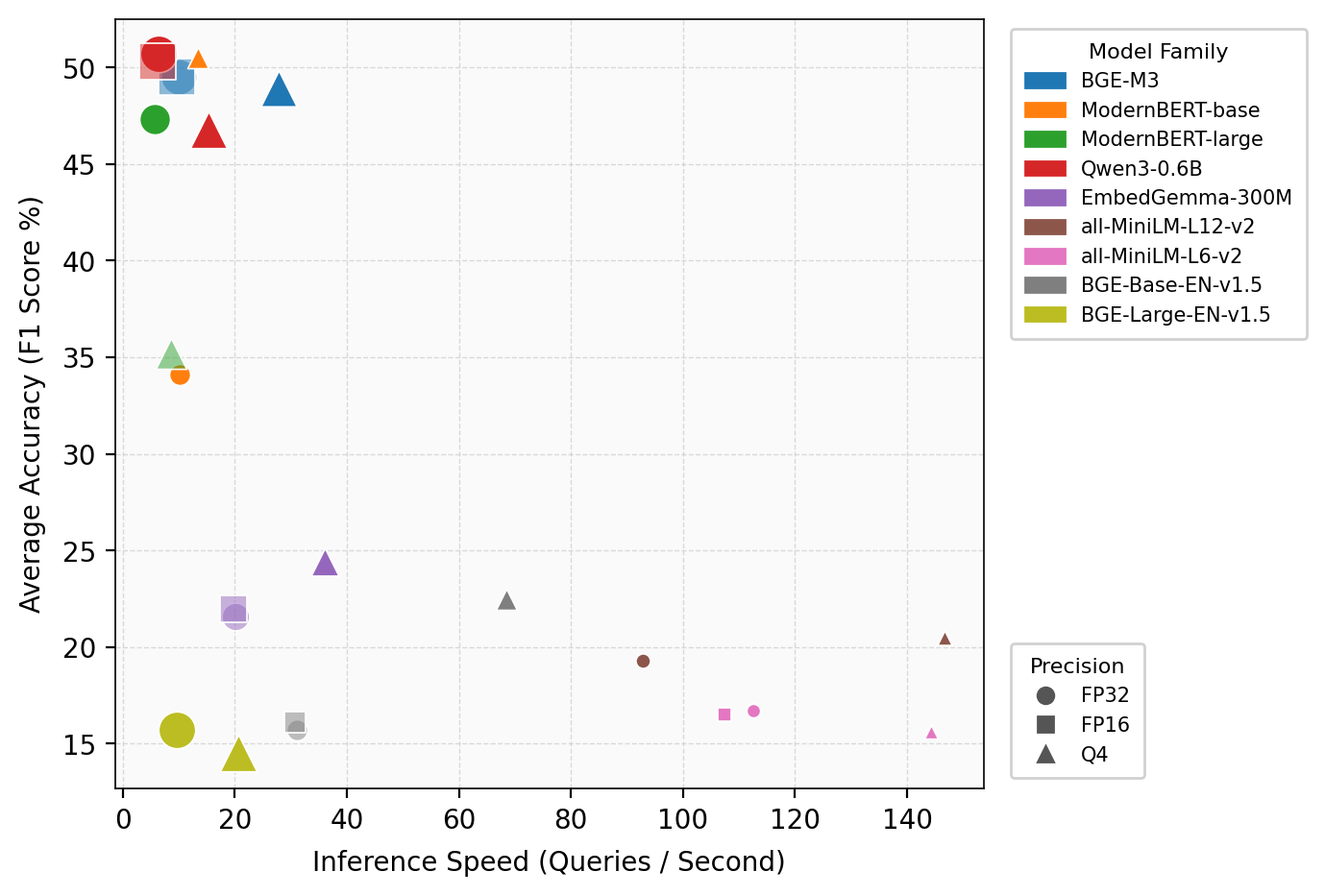
6. Performance Results
6.1 Full condensed results
Sorted by descending F1, then throughput:
| Rank | Model | Precision | Throughput (QPS) | Accuracy F1 |
|---|---|---|---|---|
| 1 | Qwen3-0.6B | fp32 | 6.36 | 50.7 |
| 2 | ModernBERT-base | q4 | 13.41 | 50.5 |
| 3 | Qwen3-0.6B | fp16 | 6.17 | 50.3 |
| 4 | BGE-M3 | fp32 | 10.02 | 49.5 |
| 5 | BGE-M3 | fp16 | 9.73 | 49.5 |
| 6 | BGE-M3 | q4 | 27.83 | 48.9 |
| 7 | ModernBERT-large | fp32 | 5.67 | 47.3 |
| 8 | Qwen3-0.6B | q4 | 15.30 | 46.8 |
| 9 | ModernBERT-large | q4 | 8.56 | 35.2 |
| 10 | ModernBERT-base | fp32 | 10.19 | 34.1 |
| 11 | EmbedGemma-300M | q4 | 35.99 | 24.4 |
| 12 | BGE-Base-EN-v1.5 | q4 | 68.42 | 22.5 |
| 13 | EmbedGemma-300M | fp16 | 19.87 | 22.0 |
| 14 | EmbedGemma-300M | fp32 | 20.15 | 21.6 |
| 15 | all-MiniLM-L12-v2 | q4 | 146.62 | 20.5 |
| 16 | all-MiniLM-L12-v2 | fp32 | 92.88 | 19.3 |
| 17 | all-MiniLM-L6-v2 | fp32 | 112.57 | 16.7 |
| 18 | all-MiniLM-L6-v2 | fp16 | 107.45 | 16.5 |
| 19 | BGE-Base-EN-v1.5 | fp16 | 30.77 | 16.1 |
| 20 | BGE-Base-EN-v1.5 | fp32 | 31.07 | 15.7 |
| 21 | BGE-Large-EN-v1.5 | fp32 | 9.60 | 15.7 |
| 22 | all-MiniLM-L6-v2 | q4 | 144.20 | 15.6 |
| 23 | BGE-Large-EN-v1.5 | q4 | 20.62 | 14.5 |
6.2 Pareto-relevant picks
| Goal | Best choice in this suite | Why |
|---|---|---|
| Maximum accuracy | Qwen3-0.6B fp32 (50.7 F1) | Top F1; long context |
| Accuracy with moderate speed | ModernBERT-base q4 (50.5 F1 @ 13.4 QPS) | Near-top F1, ~2× Qwen fp32 throughput |
| Best quality/speed balance | BGE-M3 q4 (48.9 F1 @ 27.8 QPS) | Near-top quality at ~3× BGE-M3 fp32 speed |
| Maximum throughput | all-MiniLM-L12-v2 q4 (146.6 QPS) | Fastest; F1 ~20.5 only |
| Small multilingual-capable deploy | BGE-M3 q4 | 8k context, strong F1, quantized size |
6.3 Performance by model type
Compact MiniLM (Type A)
- Dominates the right side of the speed axis (90–147 QPS).
- F1 stays in the 15–21 band—lowest quality cluster.
- L12 slightly better F1 than L6; L6 slightly faster at fp32 but L12 q4 wins absolute speed.
- Interpretation: excellent indexers for high-volume approximate search; weak primary retrievers for this RAG set.
Classic BGE-EN (Type B)
- Base q4 is surprisingly competitive on speed (68 QPS) with modest F1 (22.5).
- Large is slow and low-F1 here (14.5–15.7)—capacity does not help on this eval; 512-token limit and English-BERT design may not match document length or domain.
- Interpretation: English retrieval specialists underperform the modern/multilingual/LLM-embedding cluster on this mixed long-doc task.
BGE-M3 (Type C)
- Forms a tight high-quality band (~48.9–49.5 F1).
- Quantization is almost free in quality and ~2.8× faster (10 → 28 QPS).
- Interpretation: the project’s flagship “balanced production” candidate.
ModernBERT (Type D)
- Base q4 is a star outlier (50.5 F1 @ 13.4 QPS).
- Base fp32 is much weaker (34.1)—investigate pooling, export, or variance before production trust.
- Large fp32 is strong (47.3) but slow; Large q4 degrades sharply (35.2).
- Interpretation: architecture is promising; precision selection is critical.
LLM-backbone (Type E)
- Qwen3 anchors the accuracy ceiling; use fp16/fp32 for max quality, q4 if you need ~15 QPS.
- EmbedGemma sits in a middle band: faster than large encoders, weaker F1 than M3/Qwen/ModernBERT-q4 on this set. Prefix formatting and domain fit may matter more than raw size.
6.4 Parameter count vs quality (project-reported sizes)
| Params (M) | Families | F1 band (best precision) |
|---|---|---|
| 22–33 | MiniLM | ~16–21 |
| 143 | ModernBERT-base, BGE-Base | ~22–51 (huge spread) |
| 294 | EmbedGemma | ~22–24 |
| 378 | ModernBERT-large | ~35–47 |
| 541–572 | BGE-M3, Qwen3, BGE-Large | ~15–51 |
Takeaway: parameter count alone poorly predicts RAG F1. Training objective, context length, and quantization interact more strongly than “bigger is better.” BGE-Large and MiniLM both can land near the bottom of F1 despite very different sizes.
6.5 Context length as a hidden performance factor
| Context window | Models |
|---|---|
| 512 | MiniLM, BGE-Base/Large EN |
| 2048 | EmbeddingGemma |
| ~8192 | ModernBERT, BGE-M3 |
| 32768 | Qwen3-Embedding |
On multi-page policy and technical documents, 512-token models rely more on chunking strategy. Long-context models can embed larger coherent units—often improving retrieval of multi-sentence answers. That aligns with the empirical cluster: long-context types dominate the top F1 ranks.
7. Architecture Deep Dive: Why Types Differ
7.1 Bidirectional encoder vs LM backbone
| Classic encoder (BERT / XLM-R / ModernBERT) | LM-backbone embedder (Qwen3 / Gemma) | |
|---|---|---|
| Attention during embedding | Fully (or hybrid) bidirectional over the sequence | Originally causal; embedding variants enable bidirectional use |
| Strength | Token-level mutual conditioning; mature pooling recipes | Rich pretraining scale; instruction following; long context |
| Cost | Scales with layers × seq² (mitigated by local attention) | Often larger vocab and deeper stacks |
7.2 Attention efficiency patterns
- Full attention every layer: MiniLM, BGE-EN, BGE-M3, Qwen3 — simple, expensive at long
. - Hybrid local + global: ModernBERT (global every few layers), EmbeddingGemma (sliding window + periodic full) — better long-sequence scaling.
- GQA (grouped query attention): Qwen3 — fewer KV heads reduce memory bandwidth.
7.3 Vocabulary and language coverage
| Vocab size | Models | Implication |
|---|---|---|
| ~30k | MiniLM, BGE-EN | Compact; English WordPiece |
| ~50k | ModernBERT | Modern English-focused tokenizer |
| ~152k | Qwen3 | Multilingual generative vocab |
| ~250k | BGE-M3 | Strong multilingual coverage |
| ~262k | EmbeddingGemma | Very large embedding matrix |
Large vocabs improve tokenization quality for rare words and non-English text but inflate model size (especially embedding tables), which is visible in ONNX disk footprints.
7.4 Task conditioning
EmbeddingGemma’s documented prefix pattern:
query:     "task: search result | query: <text>"
document:  "title: none | text: <text>"
Instruction-style embedders are asymmetric: query and document are not interchangeable. Pipelines must apply the correct prefix on both index and search paths—or quality collapses.
Classic MiniLM/BGE-EN often use simpler symmetric or lightly asymmetric formats. Always match the model card’s recommended template.
8. ONNX Deployment Considerations
8.1 Why ONNX for embeddings
- Portable runtime (CPU, some GPU EPs) without full PyTorch
- Mature quantization tooling (
onnxruntime.quantization, Optimum export) - Predictable ops for production serving
8.2 Approximate on-disk sizes (illustrative)
| Model | fp32 order of magnitude | q4 order of magnitude |
|---|---|---|
| MiniLM-L6 | ~87 MB | ~52 MB |
| MiniLM-L12 | ~127 MB | ~59 MB |
| BGE-Base | ~416 MB | ~143 MB |
| ModernBERT-base | ~572 MB | ~215 MB |
| EmbedGemma-300M | ~1.2 GB | ~188 MB |
| BGE-M3 | ~2.2 GB | ~543 MB |
| Qwen3-0.6B | ~2.3 GB combined | ~872 MB |
| ModernBERT-large | ~1.5 GB | ~403 MB |
| BGE-Large | ~1.3 GB | ~303 MB |
Quantization is often the difference between “fits on a laptop edge node” and “needs a dedicated volume.”
9. Practical Selection Guide
9.1 Decision matrix
| Scenario | Recommended type | Concrete pick (this benchmark) |
|---|---|---|
| Interactive RAG, quality first | LLM-backbone or multi-function | Qwen3 fp32/fp16 or BGE-M3 fp32 |
| Interactive RAG, balanced | Multilingual multi-function @ q4 | BGE-M3 q4 |
| Strong quality, modest hardware | Modern encoder @ q4 | ModernBERT-base q4 (validate on your data) |
| High-QPS logging / bulk embed | Compact sentence transformer | MiniLM-L12 q4 |
| Multilingual + long docs | Type C | BGE-M3 |
| Very long documents (>>8k) | Type E decoder | Qwen3-Embedding |
| English short FAQs only | Type A or B | MiniLM or BGE-Base q4 |
| Strict disk budget | Small + q4 | MiniLM q4 or BGE-Base q4 |
9.2 Anti-patterns suggested by the data
- Assuming larger classic BERT is better — BGE-Large underperformed BGE-Base and MiniLM on F1 here.
- Deploying only fp32 for “safety” — BGE-M3 loses almost nothing at q4 and nearly triples QPS.
- Using MiniLM as sole retriever for hard multi-hop or long-doc RAG — speed is excellent; grounded answer F1 is not.
- Ignoring instruction prefixes on Gemma-style models.
- Trusting a 15-question ranking as universal truth — always re-eval on your own corpus.
9.3 Suggested production defaults from this suite
- Default production:
BGE-M3+q4 - Max accuracy offline / low QPS:
Qwen3-0.6B+fp16orfp32 - Budget CPU API:
ModernBERT-base+q4after domain validation - Batch preprocessing only:
all-MiniLM-L12-v2+q4
10. Limitations of the Study
- Small evaluation set (15 questions) → wide confidence intervals on F1.
- Single generator LLM → F1 couples retrieval with that model’s reading behavior.
- CPU ONNX path may not mirror GPU TensorRT/CUDA rankings.
- Incomplete precision grid — not every model has every precision in the summary JSON.
- No pure retrieval metrics in the article summary (e.g., nDCG@k, Recall@k) even though detailed RAGChecker reports may contain retriever-specific fields.
- Domain bias toward the three chosen documents.
- Parameter counts in plots are report conventions, not always identical to Hugging Face model cards.
11. Related Landscape (Beyond This Repo)
For context, other embedding types practitioners meet outside this project:
| Type | Examples | Role |
|---|---|---|
| Sparse lexical | BM25, SPLADE | Keyword precision; often hybridized with dense |
| Multi-vector / late interaction | ColBERT | Higher recall cost; token-level matching |
| API commercial embedders | OpenAI, Cohere, Voyage | Strong quality; external dependency |
| Multimodal | CLIP, SigLIP | Image–text spaces (out of scope here) |
| Code embedders | Voyage-code, StarEncoder | Programming languages |
This repository focuses on local, dense, text-only, sub-1B, ONNX models—the set most relevant to self-hosted RAG.
12. Conclusion
Embedding models are not a single product category. In this project they appear as at least five architectural types—compact sentence transformers, classic English retrieval BERTs, multilingual multi-function encoders, modern long-context encoders, and LLM-backbone embedders—further subdivided by precision.
Empirically:
- Quality leaders: Qwen3-0.6B (fp32/fp16), ModernBERT-base (q4), BGE-M3 (all precisions).
- Speed leaders: all-MiniLM variants (especially L12 q4).
- Best overall tradeoff: BGE-M3 q4 (~48.9 F1 at ~28 QPS).
- Quantization is a first-class design choice: sometimes nearly free (BGE-M3), sometimes costly (ModernBERT-large, Qwen3), occasionally oddly beneficial on small evals (ModernBERT-base).
- Context length and training recipe explain more of the F1 ranking than raw parameter count.
For engineers building RAG systems, the actionable message is simple: type the problem first (language, document length, QPS, disk), then pick an architecture class, then choose the precision that sits on your accuracy–latency Pareto frontier—and re-measure on your documents.
Appendix A — Model Inventory
| Local directory | Hugging Face-style identity | Type |
|---|---|---|
all_MiniLM_L6_v2 |
all-MiniLM-L6-v2 ONNX | Compact sentence transformer |
all_MiniLM_L12_v2 |
all-MiniLM-L12-v2 ONNX | Compact sentence transformer |
bge_base_en_v1dot5 |
bge-base-en-v1.5 ONNX | Classic EN retrieval |
bge_large_en_v1dot5 |
bge-large-en-v1.5 ONNX | Classic EN retrieval |
bge_m3 |
bge-m3 ONNX | Multilingual multi-function |
modernBERT_base |
ModernBERT-base | Modern encoder |
modernBERT_large |
ModernBERT-large | Modern encoder |
qwen3_embedding_0dot6b |
Qwen3-Embedding-0.6B ONNX | LLM-backbone |
embeddinggemma_300m |
embeddinggemma-300m ONNX | LLM-backbone (Gemma3) |
Appendix B — Key Numbers at a Glance
Best F1:          Qwen3-0.6B fp32          50.7
Near-best F1:     ModernBERT-base q4       50.5   @ 13.4 QPS
Balanced:         BGE-M3 q4                48.9   @ 27.8 QPS
Fastest:          all-MiniLM-L12-v2 q4    146.6 QPS  (F1 20.5)
Slowest (fp32):   ModernBERT-large fp32     5.7 QPS  (F1 47.3)
AI Generated Report